
How Do You Pick Wine Bottle Corks Without Getting Burned? I Tried Four Types of Agglomerated Corks
2026-10-30 17:19:44
A while back a friend who does small-batch winemaking asked me to help him pick Wine Bottle Corks. He'd been using natural whole cork stoppers. Quality was great, but he couldn't get the cost down. And most of his wines are meant to be drunk within two or three years, so natural corks were kind of overkill. He asked if there was something better suited to his setup.
I told him about agglomerated corks. But here's the thing – Wine Bottle Corks come in several types. You can't just grab any one and call it a day. So I got samples of all four and tried them myself before I understood the differences.
What are agglomerated corks, and what kind of wine are they for
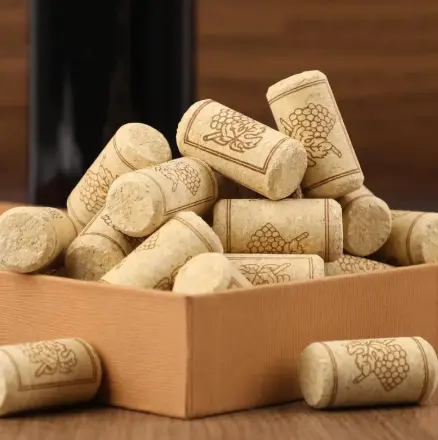
Agglomerated wine corks are made by grinding cork into granules and pressing them together with food-grade adhesive. Compared to natural whole cork, they serve a different purpose. Natural corks are better for high-end wines that need long aging. Agglomerated corks are better for short-to-medium storage and everyday drinking wines.
The biggest thing about agglomerated corks is consistent density. Since the granules are re-pressed, every cork has roughly the same density and elasticity. No tight one, loose one situation when you're using them in bulk. The seal is consistent, and the opening experience is the same every time. That's a big deal for small-to-medium winemakers
Another plus – the price is more predictable. Natural corks are graded and priced accordingly, and the good ones aren't cheap. Agglomerated corks have more stable costs. For wineries or home winemakers focused on everyday wines, that means more budget for the wine itself.
What's the actual difference between these four types?
This batch of Wine Bottle Corks comes in four types: imported agglomerated molded fine grain, imported agglomerated fine grain, imported agglomerated standard grain, and Chinese agglomerated standard grain.
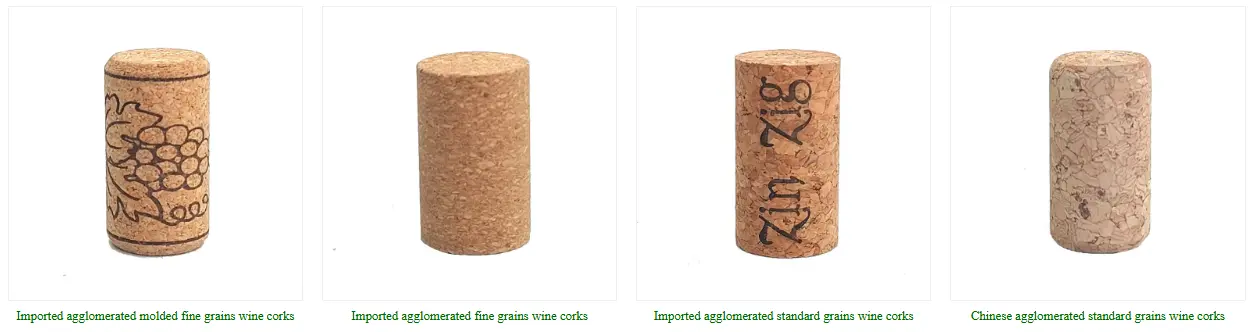
Imported molded fine grain has the finest particles, smoothest surface, and highest density. It fits tight in the bottle mouth. Good for wines where you want a really reliable seal. If you're making something mid-to-high-end and plan to age it three or four years, this one works.
Imported fine grain is slightly coarser than molded, but the surface is still smooth. The seal is close to molded. I bottled the same wine with both and opened them three months later. No real difference in how the wine held up. For most everyday wines, imported fine grain is plenty. And it costs less.
Imported standard grain is coarser. You can see the grain on the surface. The seal is fine for daily use, and the elasticity is good. Good for wines you'll drink within a year or two, or batches where you're watching costs.
Chinese standard grain is the best value. Particle size is similar to imported standard, and the seal is totally fine for everyday use. Costs way less than imported versions. For tight budgets or high-volume use, it's a solid choice. For everyday drinking wine, you won't feel like you're settling.
Seal, elasticity, opening experience – I tested each one
For seal, I soaked all four in water for 24 hours. Pulled them out – no swelling, no warping. Sizes stayed stable. The imported molded recovered fastest. Chinese standard was a bit slower. Not a big gap.
For elasticity, I squeezed each one and let go. All four bounced back to near their original shape. Imported molded snapped back fastest and most completely. Chinese standard was slightly slower, but totally fine for daily use.
For opening, all four pulled out smooth. No breaking, no crumbs. Molded and fine grain have smoother surfaces, so they come out easier. Standard grain feels slightly rougher, so there's a bit more friction. Takes a little more effort, but nothing crazy.
Size and customization – covers most regular needs
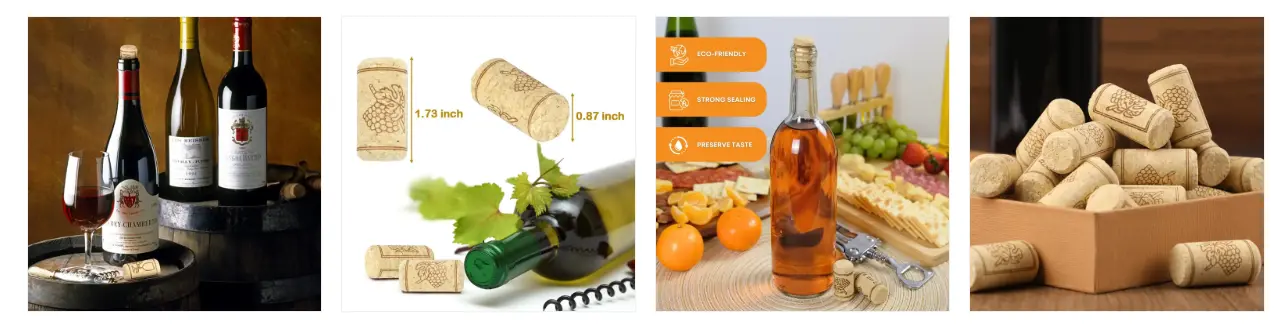
Standard size is 44mm long, 23.5mm diameter. Fits most standard wine bottle mouths. Custom sizes available for special bottle types.
You can print logos or designs on the surface. Agglomerated cork surface is flatter than natural cork, so printing comes out clearer. No broken lines from surface pores. For brands that need their logo on the cork, that's a practical advantage.
Wrapping up
I used to think agglomerated corks were all pretty much the same. After trying these four, I realized that's not true. Different particle sizes and different origins make a noticeable difference in seal and feel. Pick the right **Wine Bottle Corks** and you control costs while keeping a reliable seal. Want to try them? Samples are available for all four. Which one you pick depends on your wine's positioning and your budget.
FAQs
Q1: How long can wine last with agglomerated corks?
Three to five years for short-to-medium storage. Everyday wines and bottles you'll drink within a year or two – agglomerated corks are plenty. For high-end wines you plan to age five years or more, go with natural cork.
Q2: Is there a big gap between Chinese and imported agglomerated corks?
Not much for daily use. Imported versions have slightly better grain consistency and faster rebound. But Chinese versions seal and hold up just fine. If you've got the budget, go mid-to-high-end. If you want value, Chinese standard works.
Q3: Do agglomerated corks break easily when opening?
Not with normal use. The density is consistent, so force is distributed evenly. None of the ones I tested broke.
Author Bio: Rue, Sales Representative at Leecork, Housewares & Furnishings Group. For product inquiries, feel free to email info@leecork.com.

You May Like
0Related Industry Knowledge