
What Are Cork Granules? A Material You've Already Seen Without Noticing
Introduction
You've probably used cork granules without knowing it. Walked on them. Worn them. Driven past them on a football field. Maybe even taken medicine that contained them.
Most people think of cork as wine stoppers or notice boards. That's the visible stuff. But the real volume of cork goes into a different form entirely: cork granules. They're the ground-up, unglamorous version of cork — and they show up in more industries than almost any other natural material.
From sports fields to shoe soles, from concrete to fireworks, cork granules are quietly doing their job. This guide walks through where they go, why they work, and what makes them different from the cork you already know.
What Exactly Are Cork Granules?
Before talking about where they go, it helps to know what they are.
Cork granules are produced by grinding the bark of cork oak trees (Quercus suber) into particles of controlled sizes. The bark is harvested every nine years without damaging the tree — a renewable cycle that makes cork one of the most sustainable materials available.
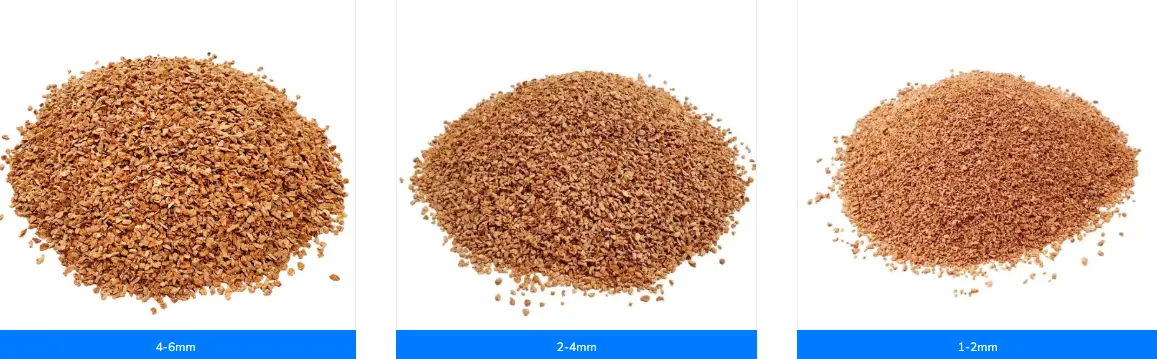
The granules themselves range from fine powder (under 100 mesh) to coarse particles (10–20 mesh). The size, density, and treatment vary depending on the application. And the applications? They're surprisingly broad.
Why Size Matters
Different applications require different particle sizes. Fine powder (100–300 mesh) works for coatings and mold release. Coarse granules (10–20 mesh) are used in artificial turf. The wrong size can break the application — too fine, and it compacts; too coarse, and it won't bind properly.
This is why understanding cork granules isn't just about knowing they exist. It's about knowing which size goes where.
Sports and Ground Surfaces
This is where cork granules have seen some of the most significant growth in recent years.
Artificial Turf Infill
Traditional artificial football fields use SBR rubber granules as infill. They work, but they have problems: they smell, they heat up in the sun, and they release microplastics. Cork granules offer a plant-based alternative.
Cork provides better shock absorption, stays cooler than rubber, and doesn't produce the same odor issues. Several European football clubs have already switched to cork-filled fields. The same applies to rugby and American football pitches.
Running Tracks and Playgrounds
When mixed with polyurethane binders, cork granules create cushioned surfaces for running tracks, basketball courts, and children's playgrounds. The natural elasticity of cork absorbs impact, which protects joints and reduces injury risk. This is not a niche application — it's standard in many modern sports facility designs. South Korea has already been using it extensively for many years.
Footwear
Cork granules have been in shoes for decades, but the technology has evolved.
Soles and Insoles
The cushioning and shock absorption of cork granules make them ideal for footwear. Birkenstock has been using cork in its footbeds for years — the material molds to the wearer's foot over time, providing custom support.
Construction and Building Materials
This is where the highest volume of cork granules is consumed.
Cork Boards and Rubber-Cork Composites
The most familiar applications. Granules are compressed into sheets with or without binders, creating insulation boards, flooring underlayment, sealing materials, and wall panels. Rubber-cork composites add durability and are used in gym flooring and industrial matting.
Lightweight Concrete
Cork granules can replace traditional aggregates in concrete, reducing weight and improving thermal insulation. Some research even explores impregnating cork with phase-change materials to enhance energy storage in building envelopes.
Coatings and Paints
Cork powder (≤0.25mm) is added to water-based paints to improve film flexibility and abrasion resistance. Not a major volume, but a specialized niche that works.
Industrial and Technical Applications
This is where cork granules get interesting.
Friction Materials
Cork powder can withstand temperatures up to 200°C, making it suitable for brake pads and clutch facings. It's not the main component, but it improves heat resistance and reduces noise.
Sealing Materials
Rubber-cork composites are used as gaskets and seals in engines, compressors, and precision equipment. The material compresses under pressure and returns to shape — reliable for sealing applications.
Mold Release Agents
Fine cork powder (≤100 mesh) is used in lead-acid battery casting as a release agent. It forms a thin insulating layer on the mold surface, improving metal flow and preventing sticking. This is a specialized but established application.
Solar Equipment Insulation
Cork granules are not used in solar cells themselves — that's a common misunderstanding. But they are used as insulation for pipes and storage tanks in solar thermal systems. Cork's low thermal conductivity and moisture resistance make it suitable for this role.
Fireworks and Pharmaceuticals
Cork powder has been used in certain fireworks compositions. In pharmaceuticals, cork granules serve as carriers for wettable powders, water-dispersible granules, insecticide smoke agents, and floating granules. These are minor but legitimate applications.
What Cork Granules Are Not
A few clarifications are worth making:
They are not a core material for solar cells. The application is insulation, not photovoltaic conversion.
They are not a replacement for everything. Each application requires specific particle size, density, and binder.
They are not limited to cork boards. That's just the most visible use.
Where the Industry Is Going
The demand for cork granules is growing, driven by:
Environmental regulations on microplastics in artificial turf
Shifting consumer preference toward natural materials
Increasing interest in bio-based construction materials
Several manufacturers are now offering cork granules specifically formulated for different applications.
The Bottom Line
Cork granules are not exciting. But they show up in more places than most people realize — from football fields to shoe soles, from concrete to brake pads. They work because they combine lightness, elasticity, thermal resistance, and sustainability better than most alternatives.
The next time you see an artificial turf field or walk on a cushioned track, there's a good chance you're standing on cork granules.
References
APCOR – Cork Sustainability and Technical Data
Research on cork granules in artificial turf (various patents and field studies)
Technical papers on lightweight cork concrete and phase-change materials
Industry reports on cork in footwear and friction materials
About the Author
Linda Song has been working with cork-based materials for [Xi’an Leecork Co., Ltd. for 15 years, supplying cork granules to industries ranging from sports to construction to footwear.
Please contact us if needed: info@leecork.com

You May Like
0Related Industry Knowledge